Week 8: Three Ideas
Published
Topic
DES303
I missed class this week, so most of what I am covering here came from catching up on what was covered and doing the thinking independently. The main focus for Week 8 was refining the design framing, specifically going back to the reverse brief and pressure testing whether the logic actually holds. That exercise turned out to be more useful than I expected, mostly because it forced me to stop describing what I am making and start defending why I am making it this way.
Before I get into the framing work though, I want to document where the three ideas actually sit right now, because they have moved on a lot from where they were a few weeks ago.
The Experience
All three concepts are circling the same core tension: AI as creative collaborator versus creative replacement. They are just three very different formats for putting an audience inside that question rather than explaining it at them.
The first is the Wearable AI Companion. A speculative promo video for a fictional wearable device built specifically for creatives, something in the space of the Apple Vision Pro but designed around the creative process rather than productivity. Glasses or a headset that sees what you are working on, stays ambient, and offers help when you are stuck without taking over. The core idea is that it assists but never creates on your behalf. The video is the actual deliverable, a fake launch film that looks and feels like it genuinely came from a future Aotearoa.
This week I shot experiments with someone wearing the headset while painting, and another with someone wearing it while taking photos. The goal was to see whether the device could feel real on camera and whether the footage had the right energy for a launch film.
Watching the footage back was useful. I also tried compositing AI-generated UI overlays onto the footage to simulate what the headset display might look like, and that part did not really work. The results looked off enough that it broke the illusion immediately, which is the one thing a fake launch film cannot afford to do. The production method is still an open problem.
I also made additional videos with AI tools to explore different visual approaches for the film. More attempts at figuring out what this thing could look like. But these did not turn out great at all - which I will note for future.
The question sitting at the end of all of this is whether I need to learn Premiere Pro and After Effects to make the compositing viable, or whether the production approach needs a rethink entirely. A bad camera test is also something I want to run in a future experiment, to see how much production quality actually matters before committing to a direction.
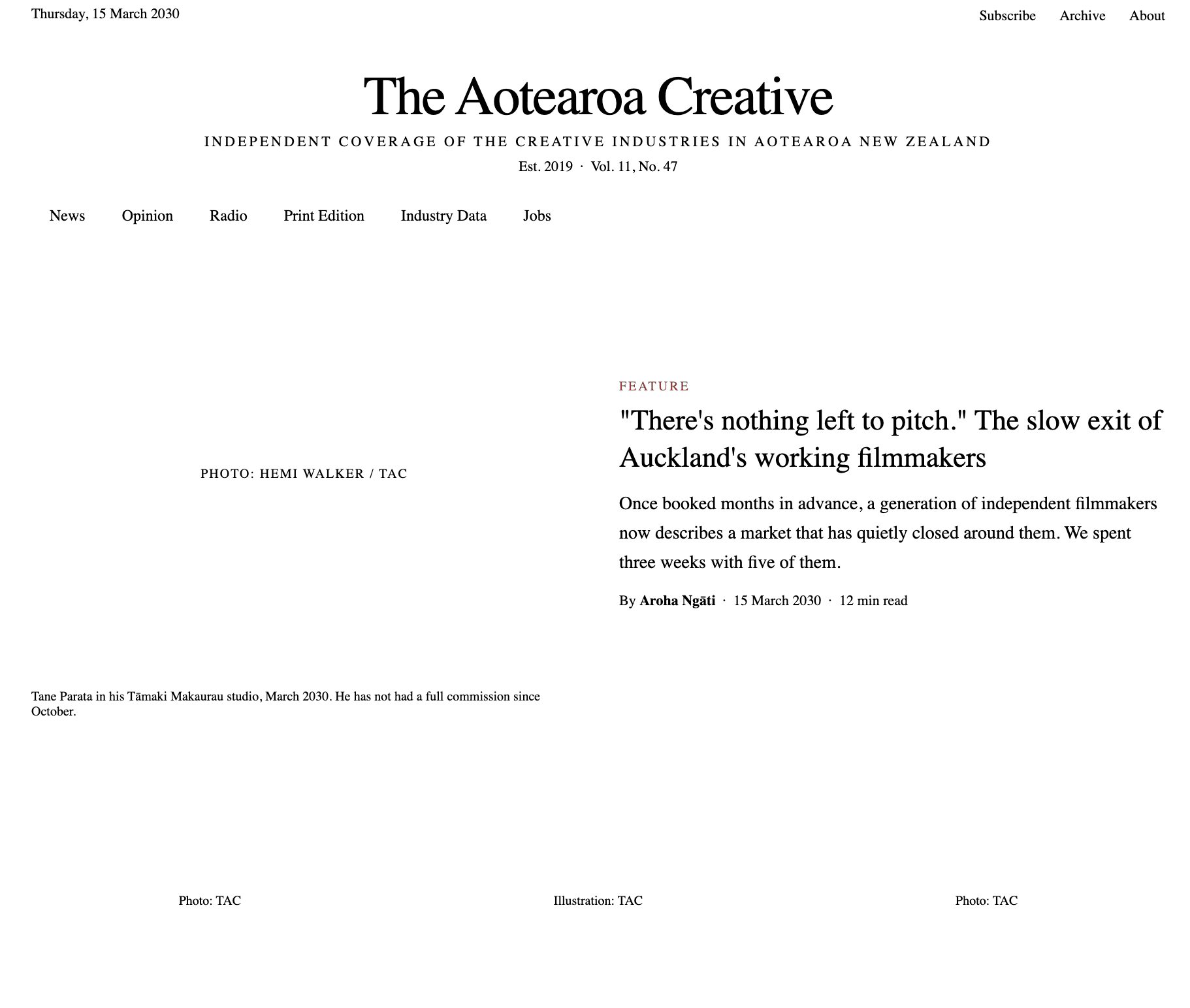
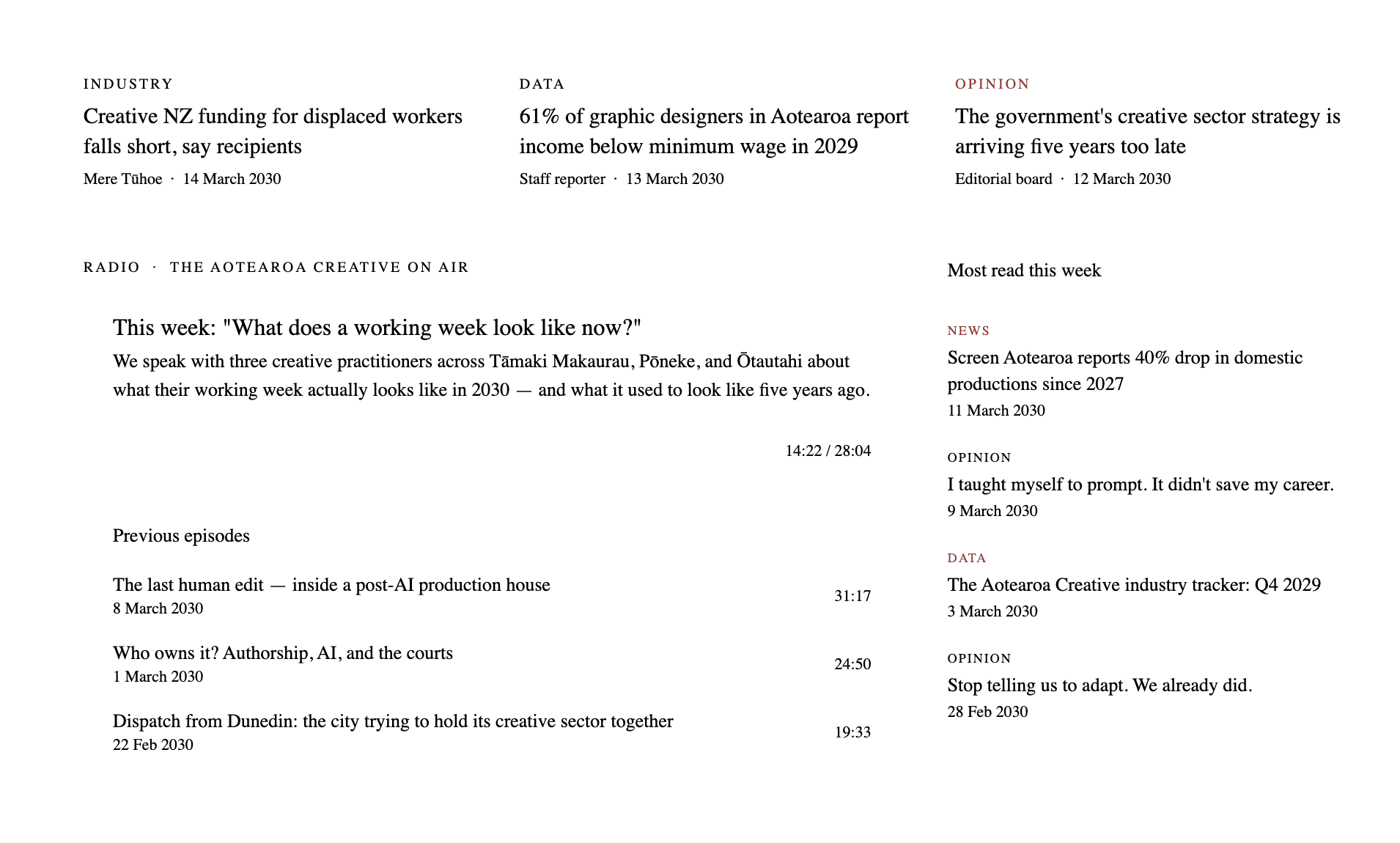
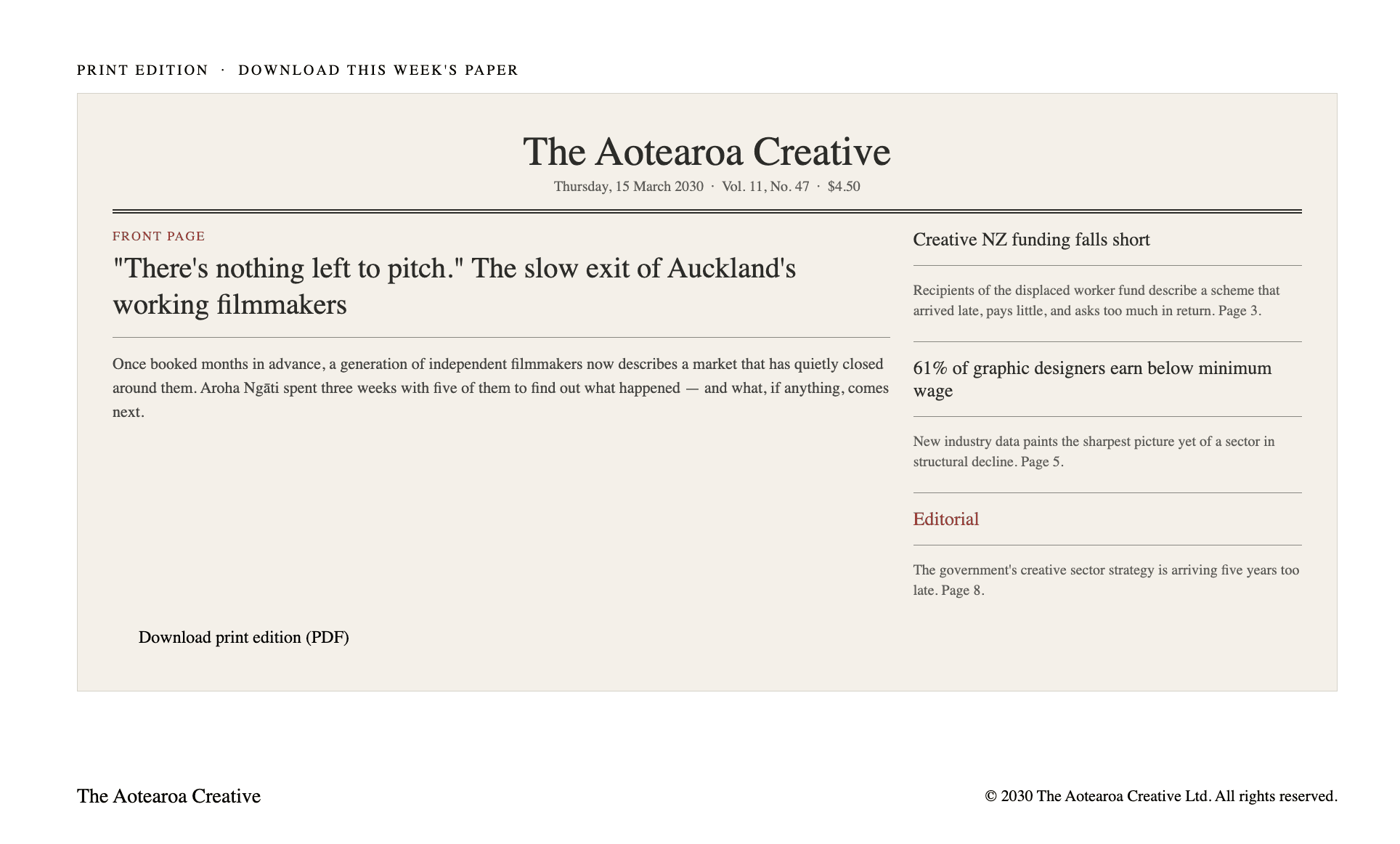
The second idea is the Journalism Publication. A speculative news website set in Aotearoa, maybe 2030 or so, that reports on the world as if AI displacement of creative work has already played out. Not explaining the future, just reporting from inside it. The familiar format of journalism does the heavy lifting. A headline, a byline, a date, and the reader is dropped into the speculative world before they have had time to question it. I built a basic version of this in Claude Code with at least one article, a radio segment placeholder, and a masthead.
https://www.loom.com/share/ea5ad4b1bc204c10b1c3a1c31ddd08b1
The emerging tech is both the subject of the publication and the tool used to make it, which gives it a self-referential quality that connects directly to the brief in a way I find genuinely interesting.
The third idea is the Emily is Away game. A choose-your-own-path game built in Claude Code, set inside a fake chat messenger interface in future Aotearoa. The player is a creative working on a project and at every decision point they choose whether to lean on the AI or trust themselves. Lean on it and things move faster but something gets lost. Resist it and it is slower but it feels more like yours. The ending reflects which path they took, but the game never tells them which was right. The responses are all pre-written, not live AI-generated, so the emotional arc stays fully in my control.
The meta angle matters here. I am using Claude Code, an AI tool, to build a game about the AI-human creative relationship. That loop is not accidental and it connects directly to the brief.
Reflection on Action
Sitting with all three of them at once this week made something clearer. None of them are arguing a position. They are all trying to create an experience. That distinction felt important when I worked through the reverse brief exercise, because it helped me understand what I am actually defending.
The project focuses on putting an audience inside the tension between AI as creative collaborator and creative replacement, through speculative formats set in a future Aotearoa. It is not trying to take a side on whether AI is good or bad for creativity. It is not solving displacement or making a policy argument. The goal is to make someone feel the weight of the choice.
This framing assumes that everyday creators in Aotearoa already feel this tension even if they have not named it, and that a speculative format can surface that feeling more effectively than a documentary or an argument would. The value driving all of this is human authorship. The feeling that what you make is still yours.
Where I think the framing could be pushed back on is the lens I am bringing to it. I spend most of my time in startup and media spaces where AI is genuinely exciting and where the people around me are mostly builders and optimists. That is not the average New Zealand creative's relationship with this technology. For a lot of people, the threat feels real and immediate, not speculative. There is also the fact that my perspective is shaped heavily by what I was seeing and hearing in San Francisco, and the brief is specifically asking about Aotearoa and New Zealand stakeholders. Those are not the same context, and I need to be honest about that gap.
The defence I keep coming back to is that the work is not trying to represent my perspective on AI. It is trying to hold space for both responses. The game is built so that neither path is framed as the right one. The journalism publication is not celebrating displacement or condemning it, it is just reporting from inside it. The launch film is not an ad for AI, it is a portrait of what a different future could look like. So even if my starting point is more optimistic than most, the outputs are designed to work for someone who is not.
The HMW question I have landed on for this project is: how might we use speculative design to help everyday creators in Aotearoa feel what it means to work alongside AI, rather than be replaced by it?
Theory
The framing here connects to what speculative design is actually trying to do. Dunne and Raby describe speculative design not as a way of predicting the future but as a way of using design to open up debate and discussion about how we want to live (Dunne & Raby, 2013). What I am trying to make sits in that territory. The three formats are not answers, they are prompts.
The idea of the diegetic prototype is also relevant here. Kirby defines diegetic prototypes as cinematic depictions of future technologies that demonstrate the technical plausibility and social utility of a new technology to large public audiences (Kirby, 2010). The launch film is the most direct version of that. But the publication and the game are doing something adjacent, using familiar formats to make a speculative world feel inhabited rather than imagined.
Preparation
The Week 9 crit is next week and I am bringing all three ideas. The plan is to get people to watch the videos and demo the game and publication directly, then take notes on the conversations that follow. The core question I want answered is which format makes people feel the tension most, and which one makes them think hardest about where they actually stand on AI and creative work. That maps back to the HMW question and gives me something concrete to measure the crit against.
The honest thing I still need to figure out before then is the film. The compositing experiments have not worked well enough yet, and I need to decide whether to keep pushing on that or accept that the production method needs to change. The publication and the game feel more ready to show. Those are the two I am most confident will hold up in a crit environment.