Week 7: Going Wide Again
Published
Topic
DES303
The Experience
The message coming out of the Week 6 crit was not subtle and I did not have much of a defence against it. Everyone said the same thing in slightly different ways: stop thinking about the experiments and actually do them. Not plan them out more carefully, not refine the concept further, just make something. So that is what this week became, though not in the way I expected, because before I could narrow down again I realised I needed to go wide one more time.
I had been sitting with the wearable AI companion and the Emily is Away style game for long enough that I was starting to confuse familiarity with confidence. The two directions had become comfortable in a way that felt a little suspicious. So I went back to the double diamond, which Jed had mentioned as a methodology and which I had found useful in Week 6 as a way of giving structure to a week without pre-determining where it would land. The logic of it is simple: you diverge before you converge, and if you are not sure whether you have diverged enough, you probably have not. I had not. So I gave myself permission to throw out completely different formats and see what surfaced.
A few ideas came up pretty quickly. A fake social media profile. A fake news article. A physical artefact. A fake podcast or radio segment. A fake job listing. None of them felt complete on their own, but something clicked when I started looking at the journalism ones together. A news article, a radio segment, a physical newspaper are not three separate ideas, they are three components of the same thing, they are all part of a media cycle, and if you build all three and house them inside a single website you do not have three experiments anymore. You have one cohesive world.
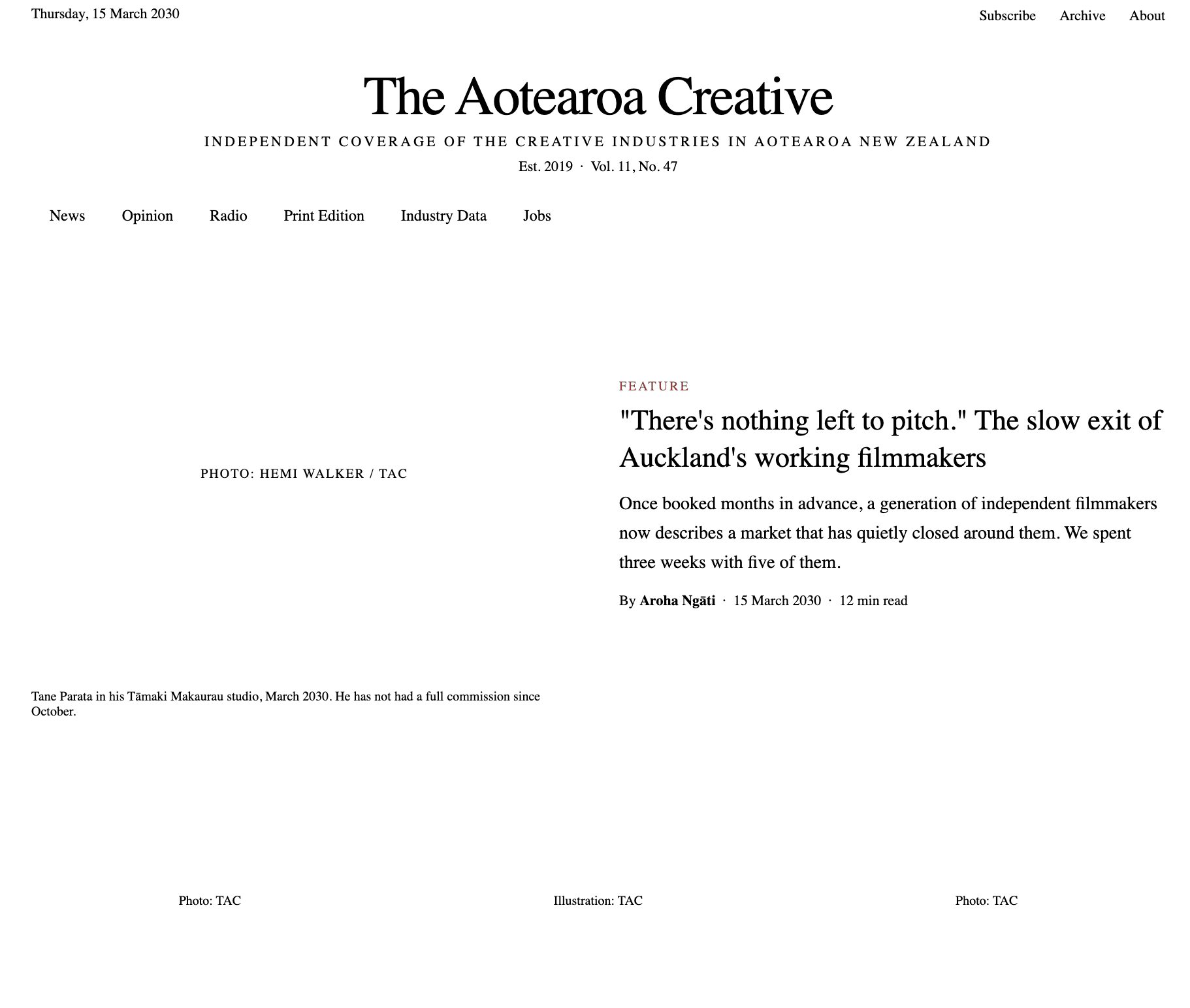
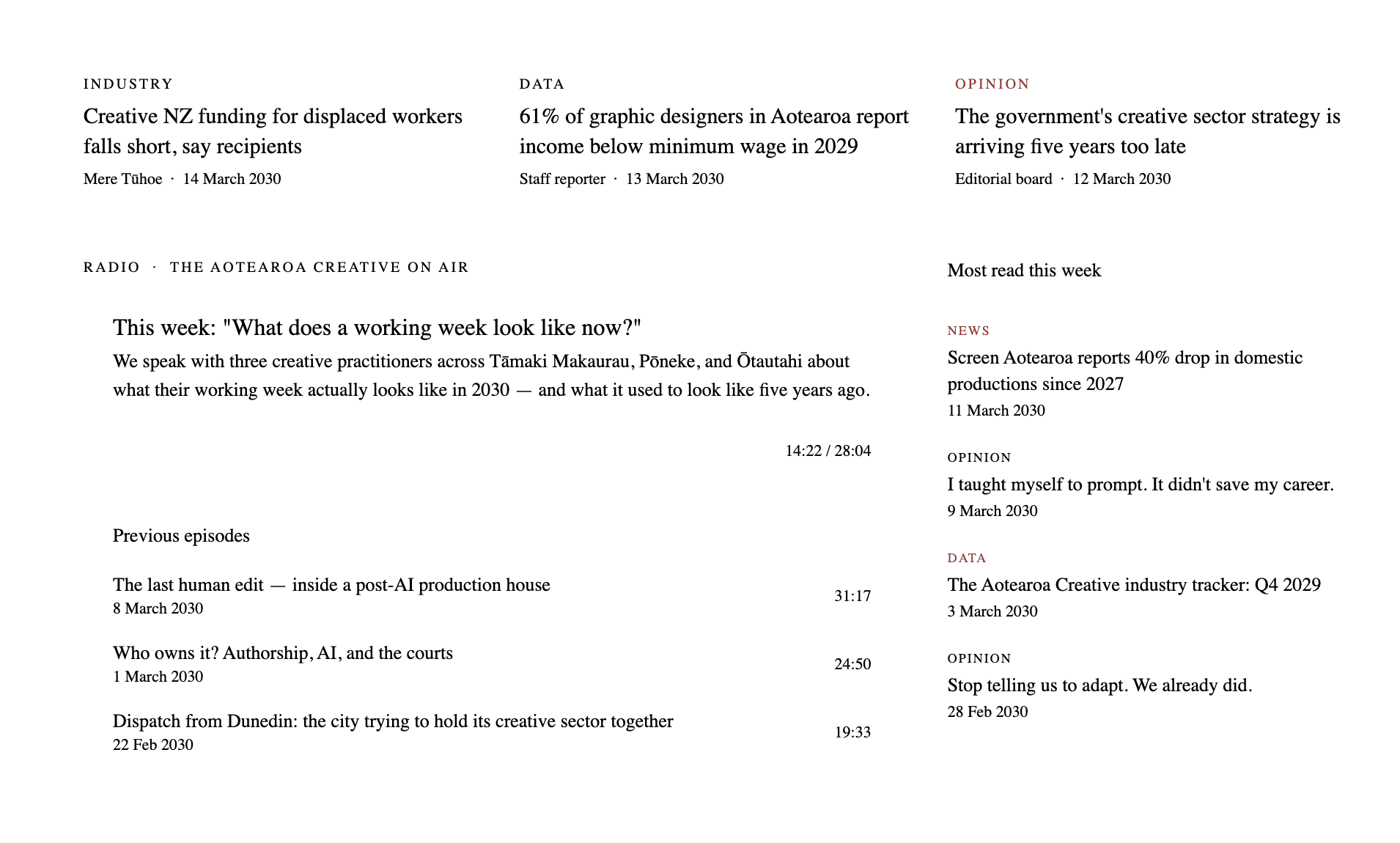
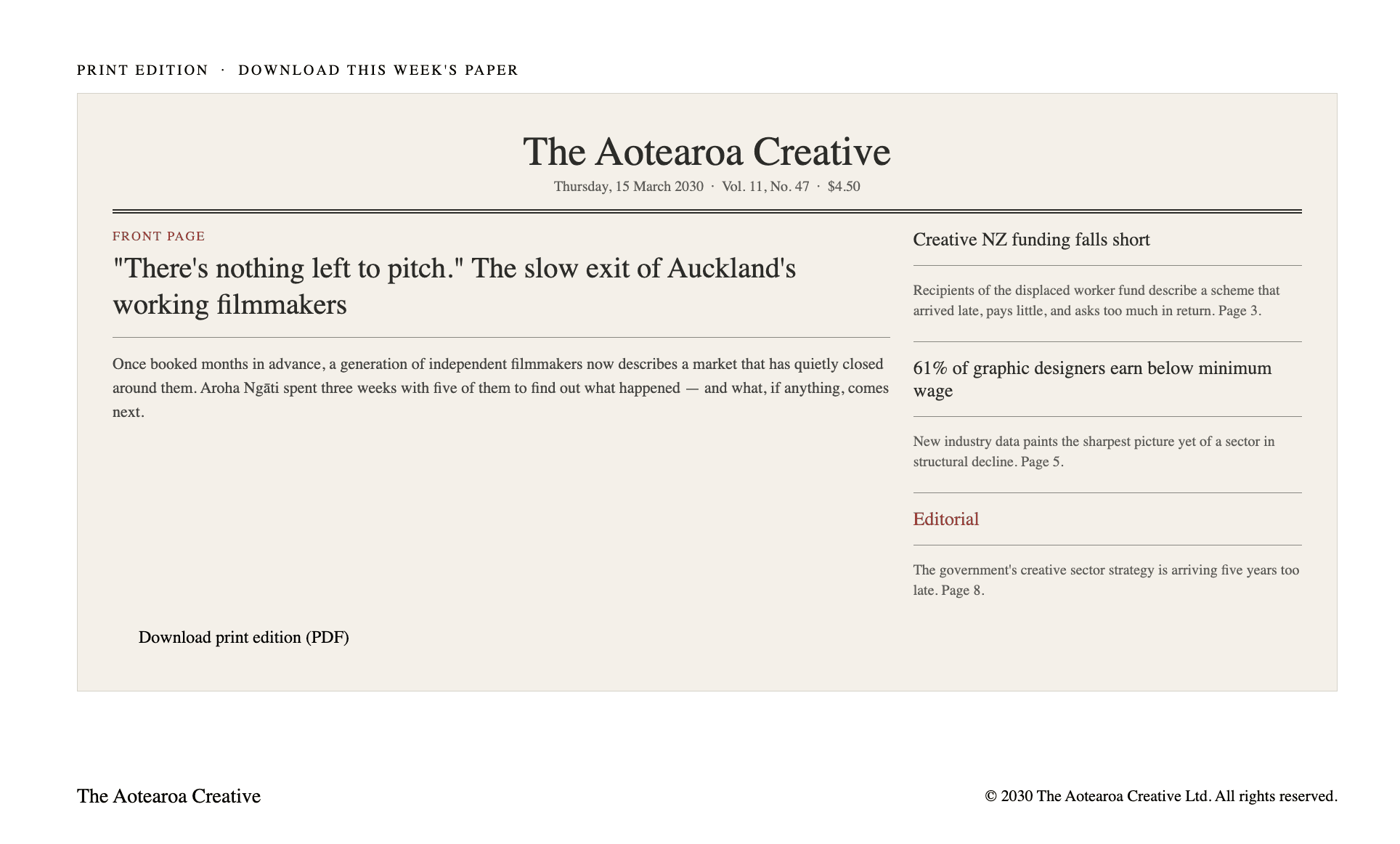
That was the moment the idea became real. A fake journalism publication from future Aotearoa. A website that looks and feels like a genuine media outlet, but everything it covers is the tension between AI and creative practitioners in a world where that tension has already played out and settled into something. The radio segment you can listen to. The newspaper you can read or download.
https://www.loom.com/share/ea5ad4b1bc204c10b1c3a1c31ddd08b1 (this should have audio if above doesn't work)
The editorial that takes a position. All of it sitting inside a publication that exists as if it genuinely came from 2035, not describing that world from the outside but reporting from inside it as if the dust has already settled.
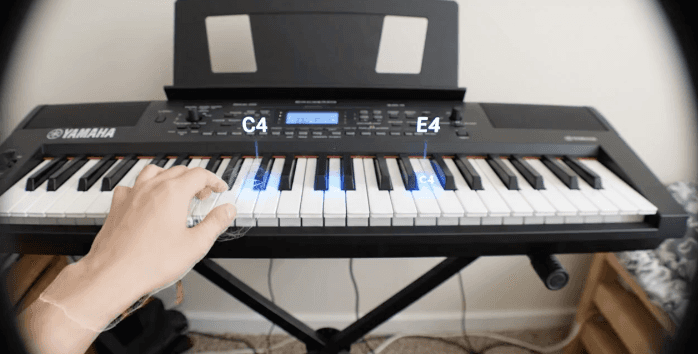
The second experiment this week pulled me back to the wearable AI companion, which had been sitting unresolved since earlier in the semester. The scenario I wanted to prototype was a pianist learning a piece with the wearable guiding them through it in real time, and the reason I started there was that it felt like the most honest version of the question the whole project is trying to ask. What does genuine creative assistance actually look like at its most basic level, when the technology is not replacing the musician but just sitting alongside them and saying this key next.
https://www.instagram.com/p/DTiNhtAjEZG/
Like a real version of this
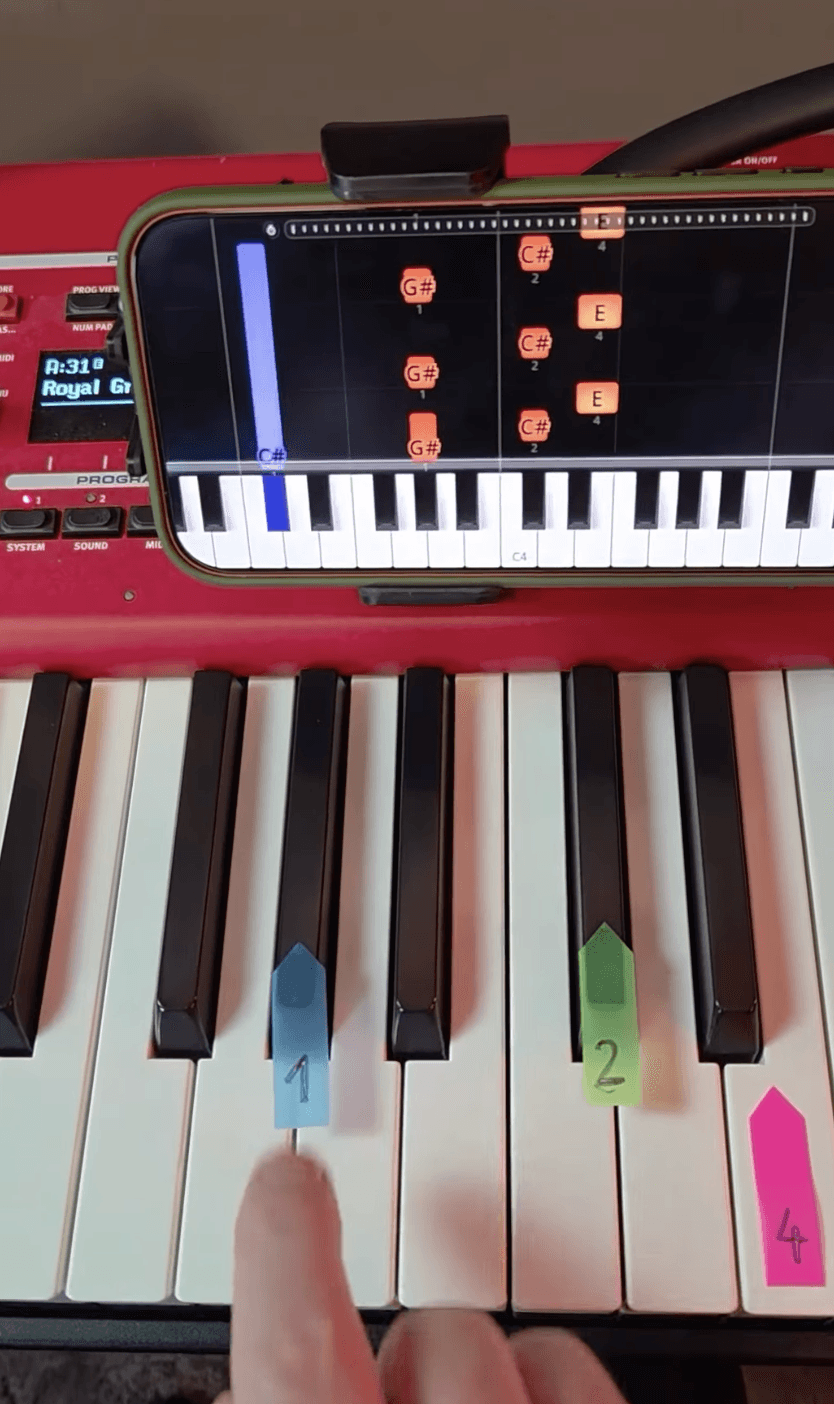
Working out what the UI should actually show took longer than I expected, because there is a real difference between an overlay that makes sense on a wearable device and one that is just a piano app someone has strapped to their face. The wearable knows what your hands are doing, it knows where you are in the piece, it can anticipate what is coming, so the overlay needed to reflect that kind of ambient intelligence rather than replicate what a screen-based tool would already do. What I landed on was glowing keys appearing just before you need to press them, note names floating above, a subtle pulse to carry the timing, and a progress bar running along the edge of the session. The device does not perform. It prompts. And that distinction turned out to be the clearest articulation of what the whole wearable concept is actually about.
I tried two approaches to making the video. The first was letting AI generate the whole thing, which gave me footage but not much control over what it was actually saying visually. The second was filming it myself and having AI composite the UI overlay on top, which felt more promising in theory because it would ground the speculative technology in something real and recognisable. That approach did not work the way I needed it to. The UI elements did not sit convincingly on the footage and the compositing broke the thing it was supposed to make more believable. So I have a concept that is clearer than it has ever been and a production method that is still an open question.
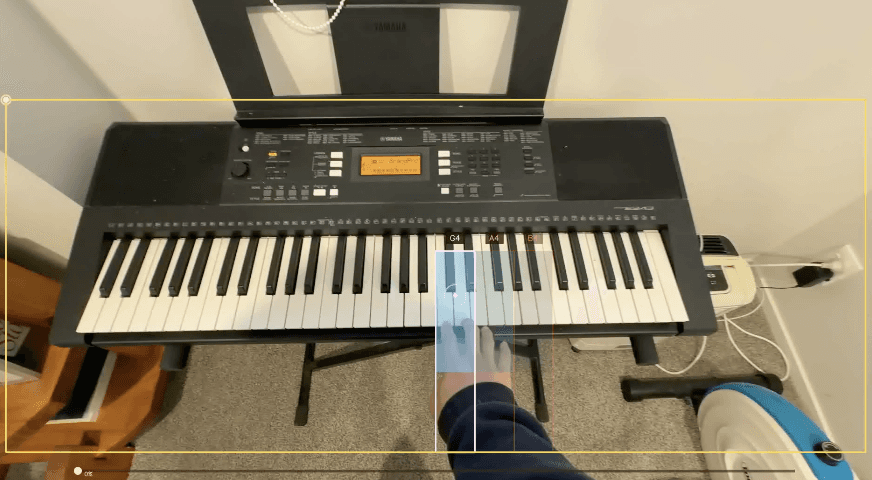
This attempt below was me filming in first person
Reflection on Action
The journalism publication idea is worth being honest about in terms of where it actually came from, because it did not arrive fully formed. It started from thinking about diegetic formats, the idea that the medium can be the artefact rather than just a container for content, which had come up in the context of the Emily is Away game earlier in the semester. Once that framing was in play the question became which formats already carry that quality of being immediately believable, and the answer was formats people already consume without interrogating them. A news article, a radio segment, a website, nobody stops to question whether those are real when they first encounter them because the brain has already processed them as real before you have had a chance to think about it. That familiarity is exactly what makes them powerful as diegetic containers for a speculative world.
Running The Next Something is probably part of why that format clicked for me as quickly as it did. I work in media storytelling every day, which means I know intuitively what a credible publication looks and feels like, what makes a headline land, what makes a byline feel authoritative, what the difference is between a website that reads as institutional and one that reads as amateur. That background made the journalism format feel immediately legible to me in a way it might not have for someone coming at this from a different practice. The positionality cuts both ways though, because the same familiarity that made the idea click quickly could also make me less likely to question whether it is actually the strongest direction or just the one I felt most equipped to execute.
The wearable video was humbling in a different and more useful way. There is a gap between having a concept clearly in your head and being able to get it out into something someone else can see, and this week made that gap very visible. The overlay approach failing was not a wasted experiment. It told me something specific about where the production problem actually lives, which is not in the concept but in the compositing, and that is a more useful piece of information than a halfway-working version would have been.
Something I keep coming back to from the image and video generation work I did in Week 6 applies here too. The tool rewards people who already have a clear vision. If you know what you want it can help you get there faster, but if you do not it just produces confident-looking noise. The pianist scenario worked as a prompt because I had already done the thinking about what the UI needed to show and why. The compositing failed because the technical execution was the thing I had not figured out yet, and no amount of prompting was going to solve a problem I had not properly defined.
Theory
The question I was really testing with the journalism publication was not whether the content was convincing. I already had a clear sense of what the tension was, AI hollowing out creative work in Aotearoa, what it looks like when creative communities stop trusting themselves and start defaulting to the machine before they have even tried. The question was whether housing that tension inside a familiar format would make someone feel like they were inside the world rather than being told about it. Whether a headline, a byline, a date of March 2030 would be enough to suspend disbelief before the critical thinking kicks in.
This connects directly to the concept of the diegetic prototype, which Dunne and Raby (2013) describe as an artefact that appears to come from a possible future rather than describing that future from the outside. The distinction matters because it changes what the audience is being asked to do. A film about AI displacement in 2035 Aotearoa asks you to watch and imagine. A journalism publication from 2035 Aotearoa drops you inside it and asks you to read. The cognitive work is different, and so is the emotional register.
The brief specifically names media artefacts from an imagined future Aotearoa as a valid outcome and uses the term diegetic prototype to describe exactly that, which meant the journalism format was not a detour from the brief but potentially the most direct answer to it. The Create lens question asks how emerging technologies might transform making practices and understandings of creativity for practitioners and creative communities in Aotearoa. That is exactly what the publication covers editorially, and the way it gets made, using Claude Code to build the website, AI audio tools for the radio segment, image generation for the visuals, means the emerging technology is not just the subject. It is part of the process. The making of the thing is inside the question the thing is asking.
The San Francisco trip sits underneath a lot of this too, even weeks later. Being surrounded by people who were already treating AI displacement as a settled fact, the doomers, the culture of building without questioning what gets lost in the process, gave me the raw material for what the publication would actually be reporting on. The world of creative communities in Aotearoa 2035 is essentially where those conversations were pointing, just landed here and given a few more years to play out into something that has its own texture and its own local specificity.
The Cluely launch video has also been in my head as a reference point for what high quality speculative product storytelling can do. It is a piece of work that feels completely real on first watch because the confidence of the format does the heavy lifting. The production, the pacing, the way it presents itself as if the product already exists and the question is just whether you are keeping up, that is the register I want the publication to sit in. Not explaining the future. Just reporting from it.
(Dunne, A., & Raby, F. (2013). Speculative everything: Design, fiction, and social dreaming. MIT Press.)
Preparation
The journalism publication needs to move from concept to something you can actually click through, and that is the primary task coming out of this week. The next step is building a basic version of the website using Claude Code, not a finished product but enough to test the core question, which is whether the format lands the way I think it will before someone is told what it is. I want at least one article, one radio segment placeholder, and a masthead that reads as credible. If someone can land on the page and spend thirty seconds inside it before they question whether it is real, the experiment has done what it needed to do.
The wearable video is a more open problem and it needs its own dedicated experiment rather than another attempt at the whole thing at once. The compositing approach failed this week and that tells me the production method is the bottleneck, not the concept. The next experiment needs to isolate that problem specifically, testing one part of the production chain rather than trying to get everything right in a single attempt. Whether that means going fully AI generated, finding a different compositing workflow, or finding a way to film that makes the overlay more convincing is still an open question, but it is a more specific open question than it was at the start of the week.
The broader target is arriving at Week 9 with two experiments that are presentable and specific enough to generate real feedback, not just proof of concepts but things someone can actually sit with and tell me whether the tension lands the way it is supposed to.